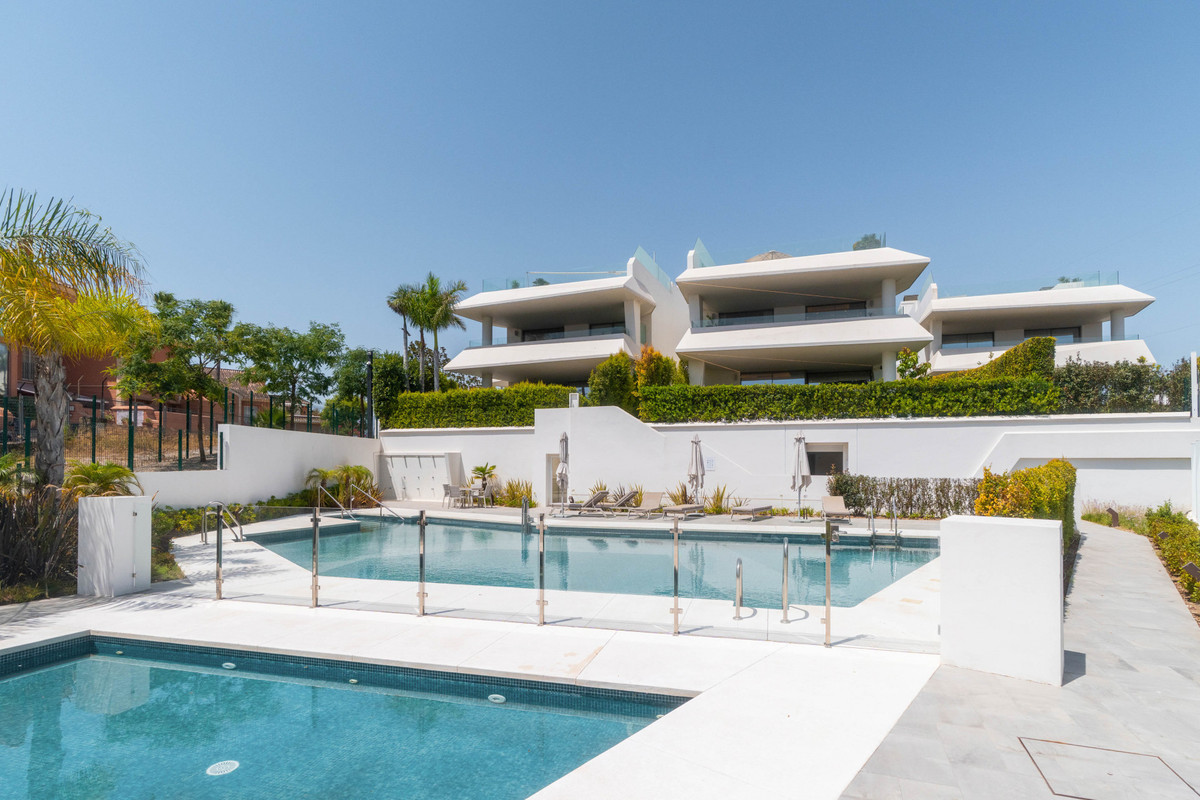
Detached Villa Nueva Andalucía
Pool
Features
We are proud to present an exceptional contemporary villa located in the heart of Nueva Andalucía, within an exclusive gated community renowned for having one of the most advanced security systems in the area, ensuring a truly private and secure living environment.
This architectural masterpiece captivates with its bold geometric design and a refined palette of natural materials in calming neutral tones.
Currently configured with three spacious bedrooms, all with en-suite bathrooms, the property also offers the possibility to create a fourth bedroom, making it a flexible home that can easily adapt to your needs.
Crafted to blend indoor and outdoor living, the villa offers a spacious covered terrace, perfect for dining and relaxing with family and friends. The custom-designed rooftop solarium with its private plunge pool showcases sweeping panoramic views over the Golf Valley and the iconic La Concha mountain.
Spread across four luxurious levels, the villa is connected by a private elevator, providing seamless access throughout. The sleek, Siematic kitchen is fully equipped with top-of-the-line appliances, and the property features underfloor heating throughout, ensuring comfort and efficiency in every season.
This home is equipped with a Lutron smart home system, offering intuitive control over lighting, blinds, and ambiance. For fitness enthusiasts, a private gym featuring premium Eleiko equipment delivers a professional training experience in the comfort of your own home.
Bang & Olufsen speakers and TVs are fully integrated into the living areas, offering a high-end audiovisual experience with timeless design appeal.
A private garage provides space for 2–3 cars, and the villa is just a short walk from all essential amenities, including restaurants, shops, and sports facilities — making day-to-day living effortless and enjoyable.
As an added bonus, the villa is sold fully furnished, with interiors thoughtfully designed by Ambience, creating a welcoming, stylish, and move-in-ready space.
This is a rare opportunity to own a truly turn-key luxury residence in one of Marbella’s most sought-after and secure neighborhoods. (It is also worth noting that existing power lines in the area are scheduled to be removed, further enhancing the surrounding aesthetics and views.)
Buying Property in Spain: Key Legal and Financial Aspects
The process of buying property in Spain differs in many ways from what buyers may be accustomed to in other countries. Below is an overview of the main legal requirements and additional costs to consider.
NIE Number (Foreigner Identification Number)
To purchase property in Spain, you need an NIE number (Número de Identificación de Extranjero), which is the tax identification number for foreigners. With this number you can:
Open a bank account in Spain
Sign the notarial purchase deed (escritura pública)
The NIE can be obtained:
At a Spanish police station
At a Spanish embassy or consulate in your home country
Through an authorized representative with a power of attorney
The processing time depends on the region in Spain.
Costs in Addition to the Purchase Price
In addition to the agreed purchase price, the buyer should budget for an extra 10–15% in costs. These include:
Transfer tax (for resale property)
VAT and stamp duty (for new property)
Notary and Land Registry fees
Legal fees
Mortgage arrangement fees (if financing is used)
Important: Spain is divided into 17 autonomous regions and more than 8,000 municipalities, meaning taxes and fees can vary. Always consult the local authorities or a legal advisor for precise information.
Detailed Breakdown of Taxes and Fees
Transfer Tax (Impuesto de Transmisiones Patrimoniales – ITP):
Applies to resale properties, typically 7–11% of the purchase price depending on the region.Value Added Tax (IVA) on new property:
For newly built properties, the VAT rate is 10%.Stamp Duty (Actos Jurídicos Documentados – AJD):
Paid together with VAT on new properties, usually around 1.5%.Notary and Land Registry fees:
State-regulated costs, usually €500–€2,000 depending on the value and location of the property.Legal fees:
Usually around 1% + VAT of the purchase price, but this varies depending on the contract’s complexity and the lawyer engaged.Mortgage arrangement fees:
Spanish banks typically charge around 1% of the mortgage amount.Property Tax (Impuesto sobre Bienes Inmuebles – IBI):
An annual local tax of 0.5–1.2% of the cadastral value, payable even if the owner is not a Spanish resident.Utility connection fees:
Costs for transferring or reconnecting utilities such as electricity, water, gas, and sewage.
How the Property Purchase Process Works in Spain
Buying property in Spain is a structured process involving several legal and financial steps. The following overview explains what buyers should expect.
1. Reservation Agreement
Once the buyer, seller, and agent agree on terms, a reservation agreement is signed, including:
The agreed purchase price
The expected completion date
The buyer pays a reservation fee (usually €6,000–€20,000) to take the property off the market.
2. Private Purchase Contract (Contrato de Compraventa)
At this stage, the buyer pays a deposit, usually 10% of the purchase price (minus the reservation fee already paid). The contract specifies:
Payment schedule
Deadlines
Agreed conditions
3. Additional Costs
In addition to the purchase price, expect around 10–15% in extra costs, including:
Transfer tax for resale property (7–11%)
VAT (10%) and stamp duty (around 1.5%) for new property
Notary and Land Registry fees (€500–€2,000)
Legal fees (about 1% + VAT)
Mortgage arrangement fee (about 1% of the loan amount)
4. NIE Number (Número de Identificación de Extranjero)
Foreign buyers must obtain an NIE to:
Open a Spanish bank account
Sign the notarial purchase deed
It can be obtained:
At a Spanish police station
At a Spanish embassy/consulate in your home country
Via a legal representative with power of attorney
Processing time: 4–6 weeks depending on the region.
5. Completion and Handover of Keys
The time between reservation and completion can vary, but fast completions are possible. On completion day, after full payment and signing the notarial deed, the buyer receives the keys and can take possession.
6. The Notary (Notario Público)
A state-appointed official whose role is to:
Verify the identity of the parties
Confirm the seller’s legal right to sell
Ensure payments comply with Spanish law
Check for debts or charges on the property
Draft and execute the public deed (escritura pública) for registration
Important: The notary does not verify the physical condition of the property.
7. Buyer’s Responsibility to Inspect
Under Spanish law, resale property is sold “as is”. It is the buyer’s duty to inspect thoroughly before signing.
Any agreed repairs or conditions must be written into the contract.
Hiring an independent surveyor/architect is strongly recommended.
8. Registration of Ownership
After signing at the notary and paying taxes/fees, the deed is filed at the Land Registry (Registro de la Propiedad). Registration usually takes 2–3 months. Once complete, the buyer receives:
The original deed
An official Land Registry certificate of ownership
Final Note
This guide outlines the key steps, costs, and legal obligations of buying property in Spain. We recommend engaging a qualified lawyer to ensure a smooth and secure transaction. If you do not yet have one, we can help you find a reliable legal advisor.