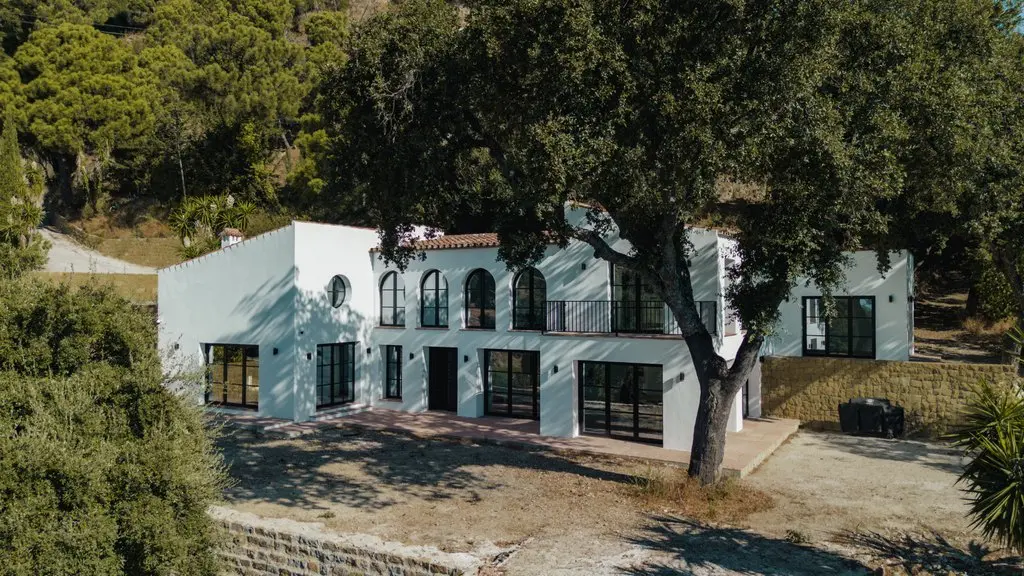
Modern classic in Casares: country villa with panoramic views of the coast
Condition
Views
A home where the views, the silence and the surrounding landscape become part of everyday living.
Set in the hills of Casares, this fully renovated villa offers a rare combination of privacy, comfort and uninterrupted views stretching across the Mediterranean Sea, Estepona and the Sierra Bermeja mountains. Surrounded by nature and complete tranquillity, it feels wonderfully secluded, yet remains within easy reach of everyday conveniences, just 25 minutes from Estepona and only 7 minutes from the main road.
The property features five bedrooms and five bathrooms, with approximately 250 m² of interior living space, plus a separate 30 m² guest studio. The design is clean, bright and timeless, inspired by Scandinavian simplicity and functionality.
The main house is arranged over two levels. On the ground floor, two bedrooms with bathrooms provide comfortable accommodation for family or guests. A striking spiral staircase leads to the upper floor, where an additional en-suite bedroom and the spacious principal suite enjoy some of the property’s finest views through large panoramic windows.
A separate studio with its own bathroom adds flexibility and can easily serve as guest accommodation, a private office, staff quarters or a creative workspace.
Significant investment has been made in upgrading the property throughout. Features include underfloor heating powered by a Daikin heat pump, individual air conditioning systems, wood-effect porcelain flooring, Villeroy & Boch bathrooms, Tres fittings and a Vela bathtub. The villa also benefits from double-glazed aluminium windows, a fully integrated home automation system, a modern security system, and completely renewed plumbing and electrical installations, all connected to mains services.
The interior is ready to move into immediately, while the garden and pool area still offer the opportunity to create outdoor spaces that reflect your own lifestyle and preferences.
Located close to the whitewashed village of Casares, approximately 30 minutes from the centre of Estepona, 40 minutes from Gibraltar Airport and around one hour from Málaga Airport, this is a property for those who value space, privacy and a slower pace of life without feeling disconnected from the Costa del Sol.
This renovated villa in Casares combines privacy, panoramic sea views, Scandinavian-inspired interiors and excellent access to the best of the Costa del Sol.
Buying Property in Spain: Key Legal and Financial Aspects
The process of buying property in Spain differs in many ways from what buyers may be accustomed to in other countries. Below is an overview of the main legal requirements and additional costs to consider.
NIE Number (Foreigner Identification Number)
To purchase property in Spain, you need an NIE number (Número de Identificación de Extranjero), which is the tax identification number for foreigners. With this number you can:
Open a bank account in Spain
Sign the notarial purchase deed (escritura pública)
The NIE can be obtained:
At a Spanish police station
At a Spanish embassy or consulate in your home country
Through an authorized representative with a power of attorney
The processing time depends on the region in Spain.
Costs in Addition to the Purchase Price
In addition to the agreed purchase price, the buyer should budget for an extra 10–15% in costs. These include:
Transfer tax (for resale property)
VAT and stamp duty (for new property)
Notary and Land Registry fees
Legal fees
Mortgage arrangement fees (if financing is used)
Important: Spain is divided into 17 autonomous regions and more than 8,000 municipalities, meaning taxes and fees can vary. Always consult the local authorities or a legal advisor for precise information.
Detailed Breakdown of Taxes and Fees
Transfer Tax (Impuesto de Transmisiones Patrimoniales – ITP):
Applies to resale properties, typically 7–11% of the purchase price depending on the region.Value Added Tax (IVA) on new property:
For newly built properties, the VAT rate is 10%.Stamp Duty (Actos Jurídicos Documentados – AJD):
Paid together with VAT on new properties, usually around 1.5%.Notary and Land Registry fees:
State-regulated costs, usually €500–€2,000 depending on the value and location of the property.Legal fees:
Usually around 1% + VAT of the purchase price, but this varies depending on the contract’s complexity and the lawyer engaged.Mortgage arrangement fees:
Spanish banks typically charge around 1% of the mortgage amount.Property Tax (Impuesto sobre Bienes Inmuebles – IBI):
An annual local tax of 0.5–1.2% of the cadastral value, payable even if the owner is not a Spanish resident.Utility connection fees:
Costs for transferring or reconnecting utilities such as electricity, water, gas, and sewage.
How the Property Purchase Process Works in Spain
Buying property in Spain is a structured process involving several legal and financial steps. The following overview explains what buyers should expect.
1. Reservation Agreement
Once the buyer, seller, and agent agree on terms, a reservation agreement is signed, including:
The agreed purchase price
The expected completion date
The buyer pays a reservation fee (usually €6,000–€20,000) to take the property off the market.
2. Private Purchase Contract (Contrato de Compraventa)
At this stage, the buyer pays a deposit, usually 10% of the purchase price (minus the reservation fee already paid). The contract specifies:
Payment schedule
Deadlines
Agreed conditions
3. Additional Costs
In addition to the purchase price, expect around 10–15% in extra costs, including:
Transfer tax for resale property (7–11%)
VAT (10%) and stamp duty (around 1.5%) for new property
Notary and Land Registry fees (€500–€2,000)
Legal fees (about 1% + VAT)
Mortgage arrangement fee (about 1% of the loan amount)
4. NIE Number (Número de Identificación de Extranjero)
Foreign buyers must obtain an NIE to:
Open a Spanish bank account
Sign the notarial purchase deed
It can be obtained:
At a Spanish police station
At a Spanish embassy/consulate in your home country
Via a legal representative with power of attorney
Processing time: 4–6 weeks depending on the region.
5. Completion and Handover of Keys
The time between reservation and completion can vary, but fast completions are possible. On completion day, after full payment and signing the notarial deed, the buyer receives the keys and can take possession.
6. The Notary (Notario Público)
A state-appointed official whose role is to:
Verify the identity of the parties
Confirm the seller’s legal right to sell
Ensure payments comply with Spanish law
Check for debts or charges on the property
Draft and execute the public deed (escritura pública) for registration
Important: The notary does not verify the physical condition of the property.
7. Buyer’s Responsibility to Inspect
Under Spanish law, resale property is sold “as is”. It is the buyer’s duty to inspect thoroughly before signing.
Any agreed repairs or conditions must be written into the contract.
Hiring an independent surveyor/architect is strongly recommended.
8. Registration of Ownership
After signing at the notary and paying taxes/fees, the deed is filed at the Land Registry (Registro de la Propiedad). Registration usually takes 2–3 months. Once complete, the buyer receives:
The original deed
An official Land Registry certificate of ownership
Final Note
This guide outlines the key steps, costs, and legal obligations of buying property in Spain. We recommend engaging a qualified lawyer to ensure a smooth and secure transaction. If you do not yet have one, we can help you find a reliable legal advisor.