Luxury Penthouse in Royal Marbella Golf
Pool
Features
This luxurious duplex penthouse is located within a prestigious golf residential complex in Marbella and boasts breathtaking panoramic views.
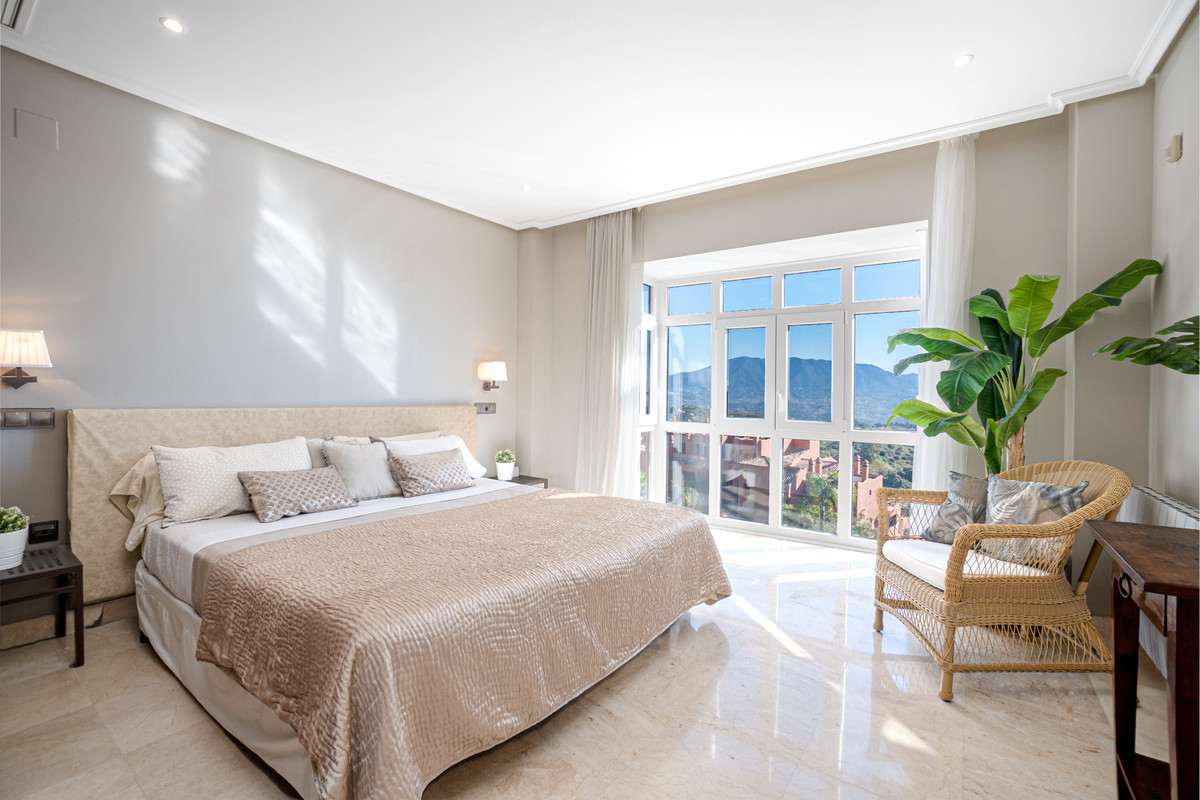
Elegantly furnished and fully equipped with high-end design features, the property is bright and spacious, offering three generously sized terraces that face both east and west, allowing for natural light and scenic vistas throughout the day.
The modern kitchen is newly renovated and comes complete with all necessary appliances, including a refrigerator, dishwasher, microwave, washer-dryer, oven, vitroceramic hob, and extractor hood.
On the lower level of the penthouse, the layout includes two bedrooms and two bathrooms — one of which is en suite — a fully equipped kitchen with a separate laundry area, and an open-plan living and dining room that features a cozy fireplace and a glazed terrace ideal for year-round enjoyment.
Upstairs, the master suite presents a retreat of comfort and elegance, with its own fireplace, a walk-in closet, and an expansive bathroom featuring both a shower and a hydromassage bathtub.
Two large terraces on this level further enhance the living experience, offering exceptional views and privacy.
All bedrooms are fitted with central air conditioning and modern ceramic radiators, each equipped with WiFi connectivity.
Set within a beautifully maintained urbanization, residents benefit from extensive amenities that include lush subtropical gardens, four swimming pools — one of which is heated — a private clubhouse, a restaurant, and an array of sports facilities.
These include a nine-hole golf course, a fully equipped gym, sauna, spa, two petanque courts, as well as tennis and paddle tennis courts, providing an active and luxurious lifestyle.
The development is located in East Marbella, near some of the most beautiful beaches on the Costa del Sol. Nestled within a UNESCO Biosphere Reserve, the surrounding natural environment is rich with wildlife and stunning landscapes.
The location also offers convenient access to a variety of shopping centers, upscale restaurants, beach clubs, and the famous Nikki Beach, all within a short drive.
This exclusive penthouse also offers direct access to a first-class nine-hole golf course and is just ten minutes away from two of the most renowned golf courses on the Costa del Sol.
From its terraces, residents can take in spectacular views of oak and pine forests, the Sierra de las Nieves mountains, the Mediterranean Sea, the Sierra Nevada, and the Mijas valley.
On clear days, one can even see the Rock of Gibraltar and the distant mountains of the Talassemtane National Park in Africa — making this a truly exceptional home in a world-class location.
This is not just any penthouse – this is luxury at its finest.
Buying Property in Spain: Key Legal and Financial Aspects
The process of buying property in Spain differs in many ways from what buyers may be accustomed to in other countries. Below is an overview of the main legal requirements and additional costs to consider.
NIE Number (Foreigner Identification Number)
To purchase property in Spain, you need an NIE number (Número de Identificación de Extranjero), which is the tax identification number for foreigners. With this number you can:
Open a bank account in Spain
Sign the notarial purchase deed (escritura pública)
The NIE can be obtained:
At a Spanish police station
At a Spanish embassy or consulate in your home country
Through an authorized representative with a power of attorney
The processing time depends on the region in Spain.
Costs in Addition to the Purchase Price
In addition to the agreed purchase price, the buyer should budget for an extra 10–15% in costs. These include:
Transfer tax (for resale property)
VAT and stamp duty (for new property)
Notary and Land Registry fees
Legal fees
Mortgage arrangement fees (if financing is used)
Important: Spain is divided into 17 autonomous regions and more than 8,000 municipalities, meaning taxes and fees can vary. Always consult the local authorities or a legal advisor for precise information.
Detailed Breakdown of Taxes and Fees
Transfer Tax (Impuesto de Transmisiones Patrimoniales – ITP):
Applies to resale properties, typically 7–11% of the purchase price depending on the region.Value Added Tax (IVA) on new property:
For newly built properties, the VAT rate is 10%.Stamp Duty (Actos Jurídicos Documentados – AJD):
Paid together with VAT on new properties, usually around 1.5%.Notary and Land Registry fees:
State-regulated costs, usually €500–€2,000 depending on the value and location of the property.Legal fees:
Usually around 1% + VAT of the purchase price, but this varies depending on the contract’s complexity and the lawyer engaged.Mortgage arrangement fees:
Spanish banks typically charge around 1% of the mortgage amount.Property Tax (Impuesto sobre Bienes Inmuebles – IBI):
An annual local tax of 0.5–1.2% of the cadastral value, payable even if the owner is not a Spanish resident.Utility connection fees:
Costs for transferring or reconnecting utilities such as electricity, water, gas, and sewage.
How the Property Purchase Process Works in Spain
Buying property in Spain is a structured process involving several legal and financial steps. The following overview explains what buyers should expect.
1. Reservation Agreement
Once the buyer, seller, and agent agree on terms, a reservation agreement is signed, including:
The agreed purchase price
The expected completion date
The buyer pays a reservation fee (usually €6,000–€20,000) to take the property off the market.
2. Private Purchase Contract (Contrato de Compraventa)
At this stage, the buyer pays a deposit, usually 10% of the purchase price (minus the reservation fee already paid). The contract specifies:
Payment schedule
Deadlines
Agreed conditions
3. Additional Costs
In addition to the purchase price, expect around 10–15% in extra costs, including:
Transfer tax for resale property (7–11%)
VAT (10%) and stamp duty (around 1.5%) for new property
Notary and Land Registry fees (€500–€2,000)
Legal fees (about 1% + VAT)
Mortgage arrangement fee (about 1% of the loan amount)
4. NIE Number (Número de Identificación de Extranjero)
Foreign buyers must obtain an NIE to:
Open a Spanish bank account
Sign the notarial purchase deed
It can be obtained:
At a Spanish police station
At a Spanish embassy/consulate in your home country
Via a legal representative with power of attorney
Processing time: 4–6 weeks depending on the region.
5. Completion and Handover of Keys
The time between reservation and completion can vary, but fast completions are possible. On completion day, after full payment and signing the notarial deed, the buyer receives the keys and can take possession.
6. The Notary (Notario Público)
A state-appointed official whose role is to:
Verify the identity of the parties
Confirm the seller’s legal right to sell
Ensure payments comply with Spanish law
Check for debts or charges on the property
Draft and execute the public deed (escritura pública) for registration
Important: The notary does not verify the physical condition of the property.
7. Buyer’s Responsibility to Inspect
Under Spanish law, resale property is sold “as is”. It is the buyer’s duty to inspect thoroughly before signing.
Any agreed repairs or conditions must be written into the contract.
Hiring an independent surveyor/architect is strongly recommended.
8. Registration of Ownership
After signing at the notary and paying taxes/fees, the deed is filed at the Land Registry (Registro de la Propiedad). Registration usually takes 2–3 months. Once complete, the buyer receives:
The original deed
An official Land Registry certificate of ownership
Final Note
This guide outlines the key steps, costs, and legal obligations of buying property in Spain. We recommend engaging a qualified lawyer to ensure a smooth and secure transaction. If you do not yet have one, we can help you find a reliable legal advisor.